top of page


The Long Christianization of Gaul
Historical Event
Pagan Survival, Syncretism & the Slow Triumph of the Church
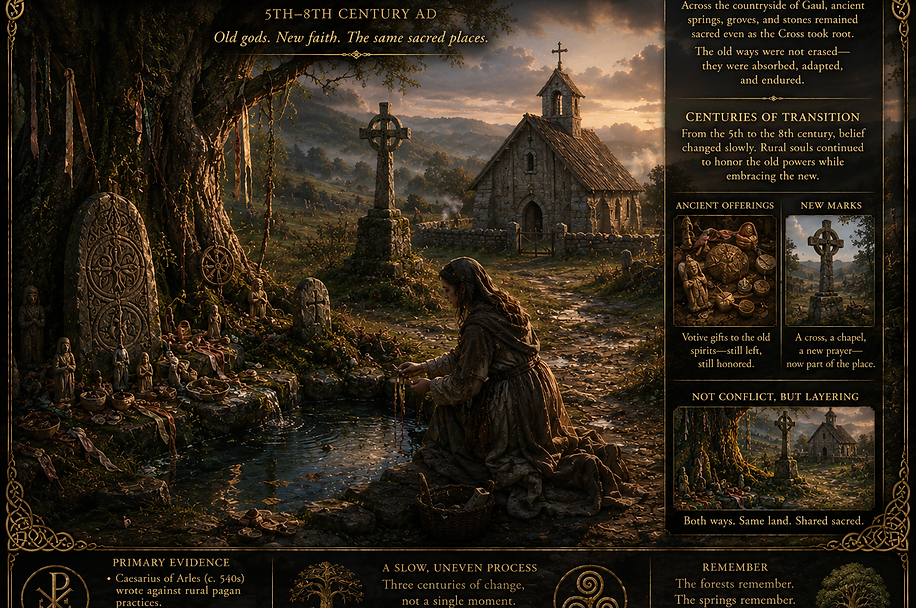
Historical Accuracy
Sulpicius Severus's Life of St. Martin, Caesarius of Arles's Sermons, and the Indiculus superstitionum et paganiarum are genuine primary sources documenting both Christian missionary efforts and the persistence of rural pagan practice well into the Merovingian period; modern historians Yitzhak Hen, Valerie Flint, Peter Brown, and Ronald Hutton have all written on this gradual, syncretic process rather than a sudden replacement. Worth flagging, as this dossier's own notes do: the historical shift of Samhain traditions toward the Church's November 1 All Saints observance occurred at or after the series' own 751 AD endpoint — any future in-story treatment of that shift should be a pointed final-book detail rather than an anachronism to avoid.
Historical Significance
Sources:
- Sulpicius Severus, Vita Sancti Martini; Caesarius of Arles, Sermons; Indiculus superstitionum et paganiarum. Modern: Yitzhak Hen, Valerie Flint, Peter Brown, Ronald Hutton.
The centuries-long, uneven process by which Gaul's older Celtic religious practices were absorbed and reframed rather than abruptly replaced by an expanding Christian Church is essential context for the entire series — it names the exact tension the whole story dramatizes: older gods, magic, and sacred sites persisting underneath an increasingly confident Christian kingdom, from Clovis's baptism through the 8th century.
Historical Era
Book I, Book V
Novel Relevance:
- Names the exact tension the whole series dramatizes: older gods, magic, and sacred sites persisting underneath an increasingly confident Christian kingdom.
Timeline:
- 316-397 Martin of Tours temple destruction; c.470-542 Caesarius of Arles attests rural pagan practice; 731-741 Rome's shift to Nov 1 All Saints; 743 Indiculus superstitionum et paganiarum.
Witch's Rebirth Canon:
- Book I Ch. 29 is dated 'October 31, 511 AD' — Samhain eve — centuries before the Church's Nov 1 observance existed.
Key Facts:
- Organized public paganism collapsed institutionally in Gaul by around the 5th century, but its practices were absorbed and reframed by an expanding Church rather than eradicated overnight.
- Martin of Tours's temple-destroying missionary campaigns (4th century) mark an aggressive early phase of this process.
- Caesarius of Arles's 6th-century sermons attest that rural pagan practices persisted long after urban Christianization was largely complete.
- The Church's Samhain-to-All Saints' Day calendar shift occurred at or after this series' own 751 AD endpoint, centuries after Book I's own setting.
the-long-christianization-of-gaul
bottom of page