top of page


The Dagda
Mythology
“The Good God”
Historical Accuracy
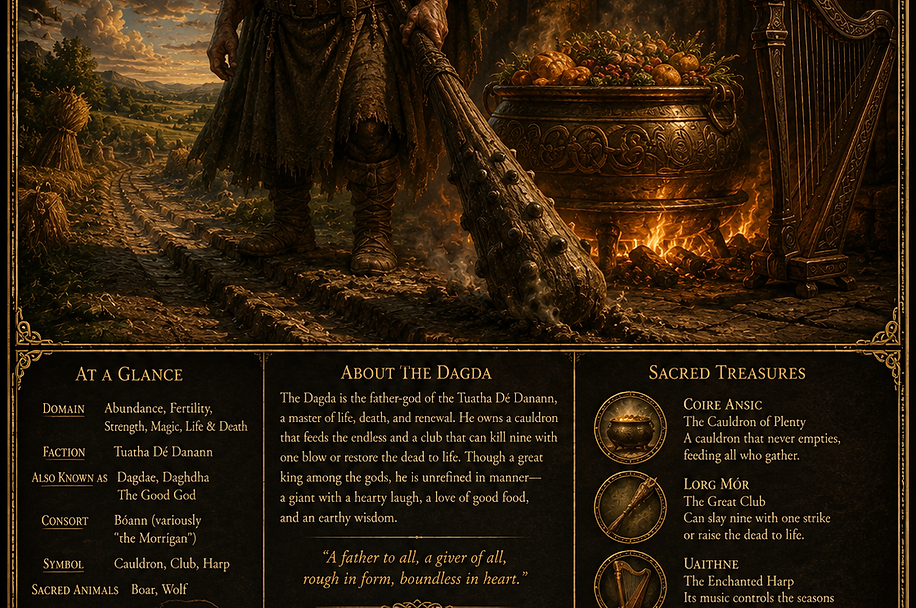
The Dagda is a genuine mythological figure, not a series invention, and his traditional depiction as a large, rough, even comic figure rather than a conventionally idealized hero-god is an attested part of the myth worth preserving rather than 'correcting' toward a more classically heroic look. His epithet 'the Good' refers to his all-around mastery of skills rather than moral goodness — a nuance the myths are explicit about and the series should preserve.
Historical Significance
Sources:
- Primary Sources
- Cath Maige Tuired, Lebor Gabála Érenn, the Dindsenchas
- Modern Scholars
- Proinsias Mac Cana, Miranda Green, James MacKillop
The Dagda ('the Good God,' Eochaid Ollathair) is one of the most important deities of the Irish Mythological Cycle, a chieftain-god of the Tuatha Dé Danann whose attested myths — his role at the Second Battle of Mag Tuired and the well-known porridge episode — make him a central, foundational figure in the surviving corpus of medieval Irish literature.
Historical Era
Book II
Novel Canon Role:
- Namesake of the Cauldron of Dagda, which Merona retrieves in Book II as part of learning her own divine lineage.
Origin & Family:
- Known as Eochaid Ollathair (“the Great Father”) and Ruad Rofhessa (“Lord of Great Knowledge”); a chieftain god of the Tuatha Dé Danann. 'Good' refers to his all-around mastery of skills, not moral goodness.
the-dagda
bottom of page