top of page


Narbonne
Location
Capital of Visigothic Septimania
Historical Accuracy
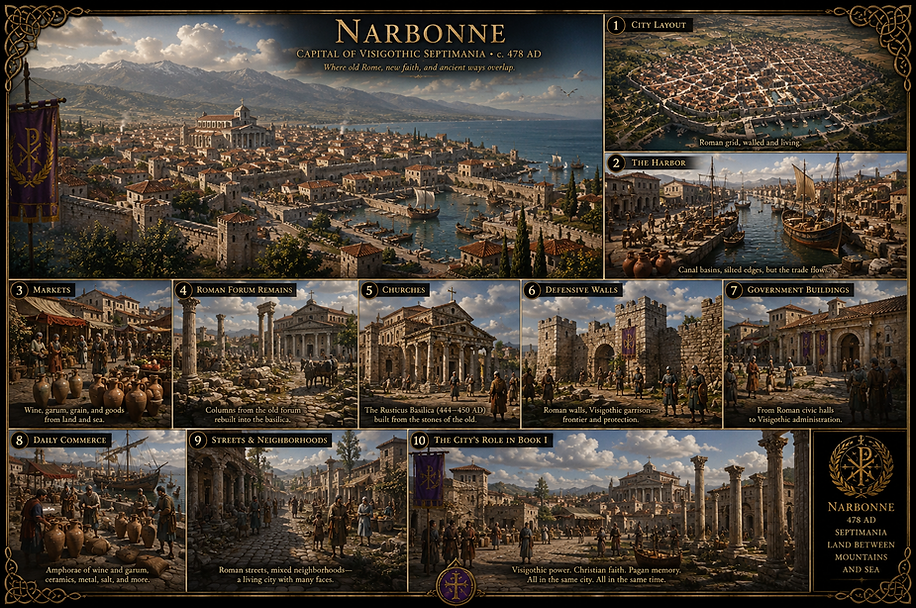
Narbonne's founding in 118 BC as Rome's first colony outside Italy, its cession to the Visigoths in 462 AD, and its status as Septimania's capital and archbishopric are all well documented through archaeological excavation (notably of the Horreum) and historical scholarship. The reuse of salvaged Roman forum columns in the city's 444–450 AD basilica reconstruction is a genuine, physically documented detail, not artistic license, and a good example of how thoroughly the Visigothic-era city was built from reused Roman fabric.
Historical Significance
Sources:
- Archaeological excavations of the Horreum (1838-1943); Narbonne and its Territory in Late Antiquity (Bryn Mawr Classical Review, 2014).
Narbonne was Rome's first colony founded outside Italy itself, in 118 BC — nearly six centuries before it became a Visigothic capital.
Historical Era
478 AD
Book I, Book II
Timeline:
- 118 BC founded; 441 AD basilica destroyed by fire; 444-450 AD rebuilt with salvaged forum columns; 462 AD ceded to Visigoths; 478 AD Book I setting; 507 AD Vouillé; 526 AD Amalaric's capital.
Book II:
The first coastal port Merona's company reaches after leaving Septimania overland by horseback in 540 AD, before continuing up and around the coast to Arelate, where they actually take ship for Corinth and, ultimately, Constantinople.
478 AD
Key Facts:
- Founded 118 BC as Colonia Iulia Paterna Narbo Martius, the first Roman colony outside Italy.
- Ceded to the Visigoths in 462 AD, becoming Septimania's capital and archbishopric.
- By 478 AD (Book I's setting), a Visigothic city built almost entirely of reused Roman fabric, including forum columns salvaged for its rebuilt basilica.
- Served as Visigothic king Amalaric's capital by 526 AD.
narbonne
bottom of page