top of page


Battle of Soissons
Historical Event
486 AD
Historical Accuracy
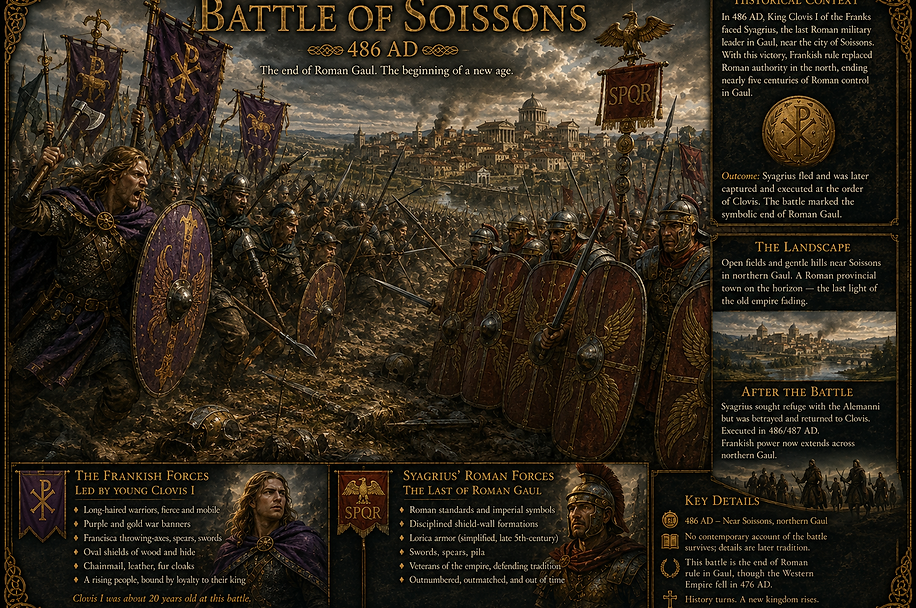
Gregory of Tours is the principal source for the battle and Syagrius's subsequent execution; the 'end of Roman Gaul' framing is a useful symbolic shorthand rather than a precise historical marker, since the Western Roman Empire itself had already formally ended in 476, a full decade earlier — Syagrius's polity was a regional successor state rather than the empire itself. Clovis's retention of much of the existing Gallo-Roman administrative structure after the conquest is well documented and reflects real continuity rather than an abrupt break.
Historical Significance
Sources:
- Gregory of Tours. Modern: Ian Wood, Bernard Bachrach.
The Battle of Soissons (486 AD), fought when Clovis I was roughly twenty years old, is conventionally treated as the symbolic end of Roman rule in Gaul and the opening act of Frankish territorial expansion — the battle that begins the process this series' Book I dramatizes as Clovis's rise to dominance.
Historical Era
486 AD · Clovis I vs. Syagrius · End of Roman Rule in Gaul
Book I
Timeline:
- 486 battle; 486/487 Syagrius executed.
Witch's Rebirth Canon:
- Book I, Ch. 10, explicitly titled 'Battle of Soissons.'
486 AD · Clovis I vs. Syagrius · End of Roman Rule in Gaul
Key Facts:
- Clovis was roughly 20 years old
- Symbolic end of 'Roman Gaul' though the Western Empire had already ended in 476
- Clovis retained much of the existing Gallo-Roman administrative structure
battle-of-soissons
bottom of page