top of page


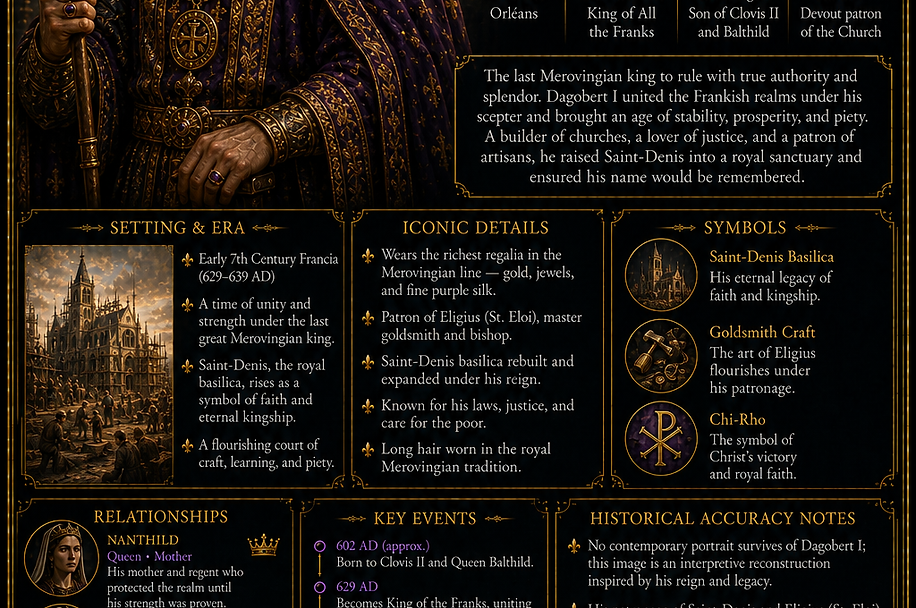
Dagobert I
Character
King of All the Franks (629–639 AD)
Historical Accuracy
The Chronicle of Fredegar is the principal narrative source for his reign, and modern historian Ian Wood's The Merovingian Kingdoms 450–751 treats his reign as this last real flowering of Merovingian royal power. His patronage of the goldsmith (and later saint) Eligius is well documented, as is his survival in later French folk memory through the children's song 'Le bon roi Dagobert' — a rare case of a Merovingian king surviving in popular memory independent of the academic historical record.
Historical Significance
Sources:
- Chronicle of Fredegar — the principal narrative source. Modern: Ian Wood, The Merovingian Kingdoms 450–751 — treats his reign as the last real flowering of Merovingian royal power before its long decline.
Dagobert I is widely regarded by modern historians as the last Merovingian king to genuinely wield personal royal authority in the manner of Clovis I and his sons — his lavish patronage of the Abbey of Saint-Denis (which became the traditional royal necropolis for French monarchs for centuries) and his real diplomacy with Byzantium and Visigothic Spain mark the final flowering of independent Merovingian kingship before power shifted decisively to the mayors of the palace after his death.
Historical Era
623–639 AD · King of Austrasia, then All the Franks · The Last Merovingian to Hold Real Personal Power
Book VI (namesake)
Novel Relevance:
- Not yet directly dramatized in the manuscript chapters reviewed to date, but his name is the direct namesake and historical anchor for Book VI (The Blood of Dagobert), which centers on his eventual successor-generation namesake, Dagobert II.
Timeline:
- c. 603 born; 623 granted Austrasia as sub-king; 629 inherits the whole realm; extensive patronage of Saint-Denis; 639 dies, buried at Saint-Denis, realm divided between sons Sigebert III (Austrasia) and Clovis II (Neustria/Burgundy).
Witch's Rebirth Canon:
- Falls between Book V's 613–639 AD span and Book VI's 656–679 AD span — his death (639) closes Book V's timeframe, and his name/legacy anchors Book VI's title even though Book VI centers on his grandson-generation namesake. His Saint-Denis patronage ties directly into the series' recurring tomb-anchor imagery established in Clovis I's dossier.
623–639 AD · King of Austrasia, then All the Franks · The Last Merovingian to Hold Real Personal Power
Birth:
- c. 603 AD.
Death:
- 639 AD, Saint-Denis.
Parents:
- Father: Chlothar II.
Reign:
- Given Austrasia as a sub-kingdom in 623, then inherited the whole reunified realm on Chlothar II's death in 629. Widely regarded as the last Merovingian king to genuinely wield personal royal authority like Clovis I and his sons — after him, real power shifts decisively to the mayors of the palace.
Key Achievements:
- Lavish patron of the Abbey of Saint-Denis, commissioning work by the goldsmith (and later saint) Eligius; Saint-Denis became the traditional royal necropolis for French monarchs for centuries
- Conducted real, documented diplomacy with Byzantium and Visigothic Spain
- Issued and revised law codes; maintained a genuinely functioning central administration
- Married multiple times (Gomatrude, set aside; then Nanthild) and kept documented concubines
Later Legacy:
- Survives in the French children's song 'Le bon roi Dagobert' — a rare case of a Merovingian king surviving in folk memory independent of the academic record.
dagobert-i
bottom of page